


Whiteboard Animation Storytelling Frameworks: How to Structure a Video Around One Clear Message
November 11, 2026 • 5 min read
A whiteboard video can explain almost anything, but only if it tells a story. Strong whiteboard animation storytelling turns a list of facts into a journey the viewer wants to follow. Without that structure, even a beautiful video falls flat.
The secret is one clear message, built around a simple framework. This guide shows you how to structure a whiteboard video so it lands every time.
Why Story Structure Matters in Whiteboard Videos
People remember stories, not bullet points. A clear structure guides attention from the first line to the last, so the message actually sticks.
Structure also keeps you focused. When every scene serves one message, the video feels tight and purposeful instead of scattered.
A clear arc helps the viewer predict where things are going. That sense of direction is what keeps them watching to the final frame.
Start With the Audience's Problem
Every good story opens with a hook, and the best hook is the viewer's own problem. Name the pain they feel, and you earn their attention in seconds.
This also makes the video about them, not you. A viewer who feels understood will stay to hear the solution.
Keep the problem specific and real. A vague opening loses people, while a sharp, relatable pain point pulls them straight in.
Introduce the Main Idea and Build a Logical Sequence
Once the problem is clear, introduce your single main idea. Resist the urge to cram in three messages, since one idea per video is the golden rule.
From there, build a logical sequence. A clean whiteboard video script structure moves step by step, so each point sets up the next without confusion.
Write the script first, before any drawing begins. The words set the pace, and the visuals follow their lead.
Use Problem, Solution, and Outcome Storytelling
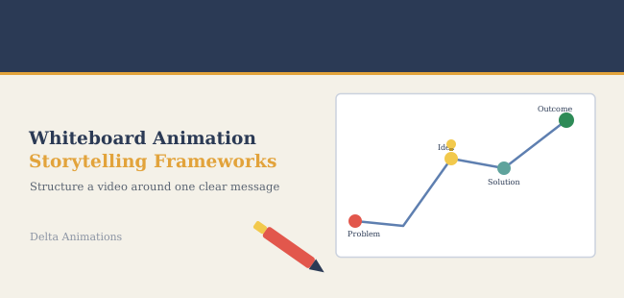
One framework works again and again: problem, solution, outcome. It is simple, familiar, and easy for any viewer to follow.
Start with the problem, present your solution, then show the happy outcome. This arc is the backbone of most effective animated storytelling techniques.
The outcome is where you seal the message. Showing the better result gives the viewer a reason to act on what they just learned.
Match Drawing Sequences to the Voiceover
In a whiteboard video, the drawing and the words must move together. The hand should sketch exactly what the narrator is describing, right as they say it.
This sync is what makes the format powerful. When the visual matches the voiceover, the viewer absorbs the idea twice, once by ear and once by eye.
Timing is everything in that pairing. A drawing that lands a beat too early or too late breaks the spell, so storyboard the two together from the start.
Keep Visual Transitions Focused on One Message
Transitions should guide the eye, not distract it. Each scene ought to flow into the next, carrying the single message forward.
Avoid flashy effects that pull focus. A strong whiteboard video narrative keeps the visuals clean, so nothing competes with the point you are making.
Erasing and replacing elements works well here. It signals a shift in the story while keeping the viewer anchored to the same simple canvas.
Adapt Storytelling for B2B, Education, and Public Information
The core framework stays the same, but the tone shifts with the audience. A business video leans on results, while an educational one leans on clarity.
Public information videos focus on simple, trustworthy steps. In every case, the story is shaped around what that specific viewer needs to understand and do.
Know your audience before you write a word. The same framework can feel formal, friendly, or reassuring, depending on who is watching.
Examples of Effective Whiteboard Story Structures
A few proven shapes fit most needs. Each one keeps the viewer moving toward a single takeaway. Pick the one that matches your message, then build every scene to serve it.
· Problem, solution, outcome: name the pain, show the fix, reveal the result.
· How-to steps: walk through a process one clear stage at a time.
· Before and after: contrast the struggle with the better way.
· Myth versus fact: bust a common misconception, then set the record straight.
Frequently Asked Questions
How do you structure a whiteboard animation story?
Start with the viewer's problem, introduce one clear main idea, then follow a logical sequence to the solution and outcome. Keep every scene focused on that single message, and match the drawings to the voiceover so the story is easy to follow.
What storytelling framework works for whiteboard videos?
The problem, solution, outcome framework works best for most whiteboard videos. It is simple and familiar, opening with a pain point, presenting the fix, and ending with a clear result. Other options include how-to steps and before-and-after structures.
How long should a whiteboard animation video be?
Most effective whiteboard videos run 60 to 90 seconds, long enough to tell one clear story without losing attention. Complex topics can stretch a little longer, but one message per video keeps it focused no matter the length.
Tell One Story, Clearly
Great whiteboard animation storytelling comes down to focus. Open with the viewer's problem, build one clear idea in a logical order, and match the drawing to every word. Done this way, a simple video can explain a big idea and make it stick.
Ready to tell your story on screen? Explore the whiteboard animation services or call (401) 206-0266 to start your project.