


Green Screen vs CGI vs Animation: What's Best for Immersive Content?
December 24, 2025 • 8 min read
The distinction between reality and digital creation is becoming ever more blurred. What notched up multi-million dollar budgets in Hollywood can now be accomplished on a smaller scale, but this is only a choice. Will you place your actors in front of a green screen and then superimpose them into the virtual world? Will you create everything digitally? Or will you create an entirely virtual world and characters?
Why This Choice Matters
When it comes to green screen or animation video production, it's really a case of which one is appropriate for the job, rather than which one can do the job best. Corporate training videos may require different considerations when it comes to green screen or animation, for example, compared to other presentations, like products or entertainment. This requires an understanding of the pros and cons of each method.
Understanding Green Screen Production
How Green Screen Technology Works
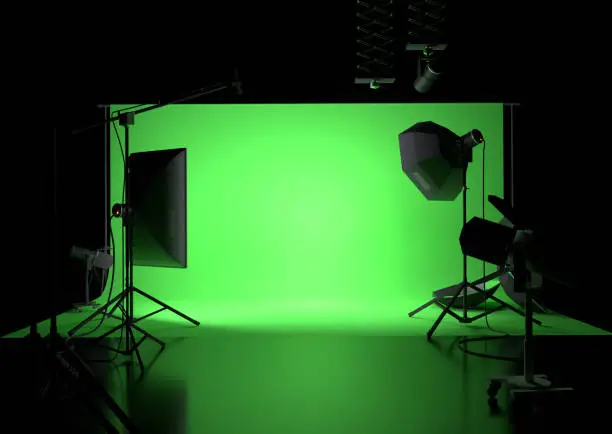
Green screen or Chroma Key is the process of recording subjects in front of a color background that is usually bright blue or green. The software can then substitute the particular color in the scene and replace it with other images or environments. This is a way of inserting real characters or objects into environments or settings that would otherwise not exist or be accessible.
When Green Screen Makes Sense
Green screen works well when you want real actors interacting in computer-generated environments. Where you have concerns about performance and emotions in content, using real actors is always authentic and cannot be replicated using green screen characters. Product demo reels requiring you to show products in impossible environments can also be done using green screen techniques.
Limitations And Challenges
Green screening needs good lighting and a lot of attention to technical details. Sometimes lighting causes shadows, mottled greens, and problematic compositions. A green spill happens when green light reflects back onto your subject and causes a colour spill that can be a pain to retouch. This is a technical problem that makes green screening far from a quick-fix solution that it could potentially be.
The Role of CGI in Immersive Storytelling
What CGI Brings to the Table
Computer-generated imagery creates pictures that are not actually there in reality. While green screen captures real elements and layers them, CGI creates everything from scratch. The fully controllable nature of every element in a CGI image brings a whole new dimension, as long as time, money, and imagination allow.
CGI for Realistic Environments
Such modern CGI allows for environments and objects that appear photorealistic and are indistinguishable from real-life footage to viewers. Architectural visualization, product visualization, and virtual environments are steadily reaching a completely real-life appearance. Such realism makes CGI very effective in content creation, in which you want to take viewers to particular places or showcase particular things completely under your control.
Stylized and Fantastical Computational Graphs
Not all CGI effects are intended to be photorealistic. Artistic CGI allows the development of distinct visual aesthetics, which can add immensely to the storytelling capabilities of films. When immersion in entertainment comes from visual aesthetic or artistry rather than deceiving the viewer’s senses by pretending it’s real, CGI has unlimited possibilities.
Animation and Immersive Experiences
The Power of Full Animation
Animation starts from scratch and doesn’t include any actual footage. No matter if it is 2D or 3D, or even stop-motion, since animation is done, it gives full control over sight. Animation has an incredible power when it is used for immersive content.
Characters and environments in animation do not go against audience expectations in the way that composited or CGI content can. The audience will accept an animated reality without reference to real-world counterparts and instead view those animated environments as they are. Therefore, immersion in animation can be achieved through style, story, and connection, as opposed to realism.
When Animation outperforms Live Action
Complex ideas are often better explained in animated form than live action. Abstract ideas, scientific processes, visualizing data, and education are examples of where you can more easily control what the audience sees and how it’s communicated. Animation has the benefit of focusing not on unnecessary detail but on what’s important.
Brand consistency is simpler to achieve with animated content. Animated characters and props are always consistent with brand identity without considering factors such as changes in lighting and location constraints as used in live-action content. Brand consistency is important for content requiring both brand identity and engagement.
Styles of Animations and their Effects
There exist various styles of animation that generate various levels of immersion. Realistic 3D animations can border on a realistic simulation generated by computer-generated imagery. Artistic 2D animations provide artistic immersion. Motion graphics provide immersion of data and concepts. Style selection has a massive impact on viewer immersion.
Costs, Flexibility, and Creativity -
Budget Matters
Green-screen filming is an expensive process that will require investment in lighting and shooting environment equipment, but this can turn out to be cheaper than filming on location. The cost of post-production is dependent on the level of complexity of the visual effects, but it turns out to be less expensive compared to a completely computer-animated shoot.
For CGI, the price will depend on complexity and how realistic it needs to be. A very simple CGI could be cheaper than doing it practically, while anything very realistic is likely more expensive than another method. The benefit is that it is cheap to reuse an existing CGI asset in different situations compared to doing it practically.
Flexibility and Iteration
Green screen is quite adaptable in post-production work on the background, but the foreground performance is fixed as it is recorded. Additional footage or changed performance shots would be expensive compared to the initial capture of footage in the case of green screen production. Hence, the adaptability of the image production process is reduced in the case of green screen as compared to the other options.
CGI and animation facilitate iteration on any given project. Not happy with a visual effect? Change it. Want to shift a color, a timing issue, or a camera angle? Fairly easy compared to revisiting actual shooting. This is very helpful in creating content that requires cycles of vetting or just optimizing content based on its effectiveness.
Creative Possibilities
Green screen allows elements from both the human and digital worlds to come together. With green screen, you can create something that is both tangible and unrealistic at the same time. Using green screen when all elements mesh well together allows you to create something that might not have been possible through pure CGI or animations.
CGI offers the greatest potential when it comes to the technology aspect. It’s simple: “If you can think it and render it, you can show it.” Camera motion, physics, lighting, and all the variables are now controllable by you; hence, when you have the control that the above offer, that’s where the creative liberty kicks in.
Choosing the Right Approach for Your Project
Evaluating Your Goals for Content
To begin, you should define what immersion looks like in your project. Are you trying to transport the audience to particular places? Developing a character relationship that evokes emotions? Breaking down difficult ideas in a simple fashion? The goal of immersion affects how you should pursue it.
Self-Assessment
Be realistic about budget, timeline, and resources. Having competent green-screen personnel is what makes green screens more practical. Having access to competent animators makes animation more practical. Your in-house resources and capabilities carry as much weight as theoretical best practices.
Hybrid Methods
You can combine multiple techniques. Some of the most popular immersive projects today involve the integration of green screen, CGI, and animations in such a manner as to harness the strengths provided by all three different options. Green screen actors in CGI environments with animated UI elements, for instance, provide depth that would otherwise be difficult to achieve by any of the three techniques on its own.
FAQs
What’s more cost-effective: green screen, CGI, or animation?
In productions that include live actors, green screen is generally the most cost-effective. That being said, green screen can depend on the level of complexity, especially if it’s a more complicated process. Basic animation may be cost-effective, but photorealistic CGI is generally the most.
Can green screen be combined with CGI or animation?
Yes. While this is often done, green screen performers can be combined with environments created using CGI and animation.
How long does it take to produce each method?
Green screen filming is the quickest but needs post-production. CGI and animation are longer to produce, but allow changes before reshoots.
Conclusion
Whether green screen vs animation video production or CGI vs animation for immersive content doesn’t have generic answers since both methods have their own set of benefits and uses for varying purposes and budgets. Green screen allows for realistic human performances under impossible scenarios. CGI allows for technical precision and photorealistic captures. Animation allows for artistic expression and idea clarity.
Sometimes the right decision is the best of both worlds, using elements of two techniques because they work well in different ways. As the tools evolve and become increasingly available, the distinctions between all of these techniques are being pushed further and further apart. What you have to focus on is understanding the underlying truths so you can make an educated decision that is right for you and your content.