


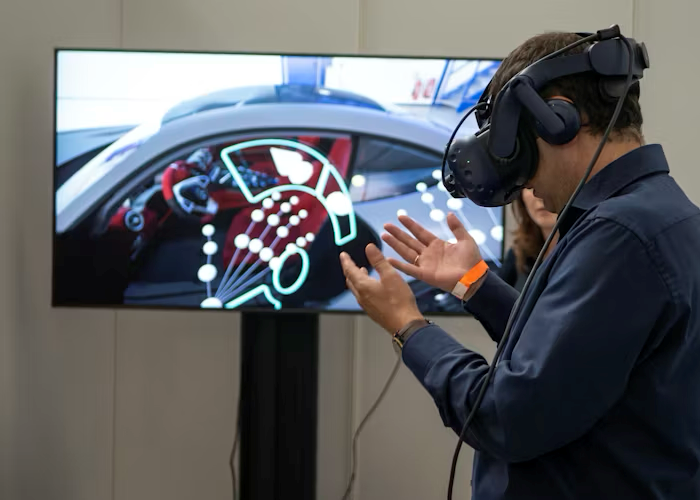
VR design in motion graphics is going to change everything we thought we knew about visual storytelling. In a flat 2D space, you control exactly what the viewer sees. You direct their attention through composition, movement, and timing. But in virtual reality? The viewer can look anywhere they want. That changes the whole game.
Traditional motion graphics are linear. You watch what is in front of you, and the story unfolds in a predictable frame. VR completely abolishes all those assumptions. All of a sudden, you are creating a complete 360-degree environment where the spectator has the power to wander around. This is both frightening and thrilling for the designers who are always given complete control over the viewer’s experience.
Why VR Is the Future of Storytelling
VR is not merely another type of screen; it is, in fact, a radical departure from all previous technologies. By putting on a VR headset, one is not simply watching a story, but actually being a part of it. That sensation of existence, of not being here but there, creates emotional ties that are simply impossible to achieve with flat media.
In the future of storytelling, this opens up a wide range of possibilities that are only in the process of being discovered. Consider a documentary where the viewer is standing in the midst of the action, rather than looking through a camera lens. Or wait for a brand to let a customer come right in and view the product from every angle, play with it, and learn it, maybe better than by a traditional video.
Immersion and 360-degree Motion Graphics
Well, for one, the immersion factor is huge. Studies show that people remember VR experiences more vividly than regular media. They feel more connected to the content. Longer, deeper engagement. For anyone trying to create memorable experiences or tell compelling stories, those benefits are hard to ignore.
360-degree motion graphics take this even further. It is not merely a static environment that you are designing; it is a space that you are infusing with life through the use of animated elements and text, effects, and visual storytelling that totally envelop the viewer. It is like being in the middle of a design that is alive and animated.
Designing Motion Graphics for 360° Experiences
Thinking in Spheres Instead of Frames
The first mental shift in understanding is that your canvas is now a sphere, not a rectangle. Every design decision needs to take into consideration the fact that content exists all around the viewer. What is behind them matters as much as what is in front.
This impacts everything: text placement, for example. You just can’t slap titles in the upper third of the frame anymore. Where is that in VR? It is necessary to think about the position of the viewer’s gaze and to put the information at the spot where he or she usually sees it. Information placed too high will be out of the viewer’s sight; too low, and the viewer will be discomforted by constantly looking up.
Not Forcing Attention but Rather Guiding It
The attention of the viewer is one of the main issues to overcome while designing VR for motion graphics. In motion graphics, you could control the composition and framing to force the viewer’s attention to where you wanted them to be. In VR, the approach has to be much more subtle.
Here, spatial audio is your greatest ally. The sound emitted from a certain direction will cause people to turn their heads naturally. If one does this along with visual cues like lighting, movement, or animated characters, one is able to redirect attention without disrupting the immersion.
Moreover, timing is of utmost importance as well. The viewer’s eye should be allowed to perceive what is significant while he or she does not feel hurried. If a key event lasts just a second and the viewer is looking the wrong way, the viewer has missed part of the story you wanted to tell. Create natural pauses in the narrative and use multiple sensory cues to control where the focus is directed.
Working with Depth and Distance
VR provides the user with real depth perception to use in the design process instead of just an illusion of it. The designer may locate the graphics in the scene at different distances from the viewer, which will result in layers that are really three-dimensional. A thing that is ten feet away seems to be and is indeed different from the text that is right in front of the eye.
This depth is a great advantage in design, but it also raises a new set of problems: elements very close can be painful to the eye, while very far ones may be hard to see or not be interactive at all, and the designer is constantly tuning the comfort and beauty.
Tools and Techniques for VR Animation
Software Options for VR Design
Unity and Unreal Engine have established themselves as the main platforms for building VR applications. Although they are intended as game engines, they are also very effective in terms of motion graphics work. You benefit from real-time rendering, physics simulation, and direct exporting to VR headsets.
In the case of motion graphics, Adobe After Effects still has a role to play, though. You are able to make 360-degree compositions, and plugins like Skybox Studio can help you with working on equirectangular footage. The workflow is the same, so if you are already good with After Effects, there is no problem; just keep in mind that you will have to think differently about how your animations work in 360 space.
Cinema 4D and Blender are ideal for creating 3D elements that fit into virtual reality environments. Whatever 3D assets you create can be imported into Unity or Unreal and positioned within your virtual space. Having strong 3D modelling skills becomes essential for VR motion graphics work.
Animation Principles That Still Apply
The great thing about VR is that it still uses the same basic animation techniques. The basic principles of animation, such as timing, easing, anticipation, and follow-through, are all still very important, and a well-animated object will always be perceived as such, no matter whether it is on a 2D screen or in 3D virtual space around the viewer.
The only difference is that these principles have to be applied in a more careful manner. An animation, for instance, that works wonders on the computer monitor may end up giving the viewer VR nausea if it is too fast or erratically moving. Generally, smooth and predictable motion would be preferred to sudden changes that are jarring.
Testing is the most important part of the process
It is impossible to design for VR without making the corresponding tests in that medium. Viewing your creation on a monitor is not the same as experiencing it. What might look okay on the screen could be irritating or just plain ineffective inside the environment.
Thus, get the headset on as early as possible and as often as needed throughout the design process. Also, test your product with others. Each individual’s experience of VR is unique, and what is comfortable for you may not be the case for someone else.
Case Studies in VR Motion Graphics
Brand Experiences
Major brands are currently using motion graphics VR design to create memorable experiences. Automotive companies let potential customers sit inside virtual cars with animated overlays showing features and specifications. Real estate firms also create virtual property tours with motion graphics highlighting key selling points as one explores.
These are much more than gimmicks; they are effective marketing means through which people come to experience products and spaces in ways that traditional media cannot match. The motion graphics elements enhance understanding while maintaining the immersive quality that makes VR special.
Educational Content
But VR is changing education, too. Medical students can explore 3D anatomical models with animated labels and explanations floating in space around them. History lessons become immersive experiences where you stand in a historically accurate environment while motion graphics provide context and information.
Presence combined with visual information allows for powerful learning experiences. When students can explore complex concepts in three dimensions with well-designed motion graphics support, they remember more and understand complex concepts better.
Entertainment and Storytelling
Innovative filmmakers and artists are experimenting with VR/AR/3D storytelling methods in captivating ways. For instance, just like in the case of animated short films, the VR medium goes on to use motion graphics to introduce the audience to narrative experiences that could not be imagined in traditional formats. In the case of VR, for example, music videos are producing such experiences that are practically synesthetic, in which the visuals are reacting to the sound that is coming from all directions around you.
The above-mentioned projects indicate how far one can go when one accepts the medium completely, rather than considering VR merely as one more screen. The best creative works have motion graphics as their partners in storytelling, while being considerate of the viewer’s right or power to look around.
Conclusion
That is the basic change: not creating content to be seen, but making environments to be felt. This calls for a different mindset, different instruments, and different methods. However, the foundation of good design remains unchanged: narrating the story, directing the audience, and bringing forth feelings through the experiences created.
If you are able, the time has come to experiment. The learning curve is steep, but the possibilities are vast. As VR technology continues to improve and become more user-friendly, the need for designers skilled in VR motion graphics will only grow. The only issue is whether you will be prepared when that happens.
Immersive and surrounding you is the future of visual storytelling. 360-degree motion graphics create a future that is alluring and magnificent. It is time to start thinking in spheres rather than in frames.
Sign Up for Our Newsletters
Get notified of the best deals on our WordPress themes.

 Delta Animations. All rights reserved | Cookie Settings, Anti-Spam, Privacy, User agreement, Legal Notice and Responsible Disclosure